What is the Model Context Protocol? A plain explanation for platform teams
What is MCP? The Model Context Protocol standardises how an agent host finds and calls tools, resources and prompts on servers. Plain guide for platform teams
This post is also available in Deutsch.
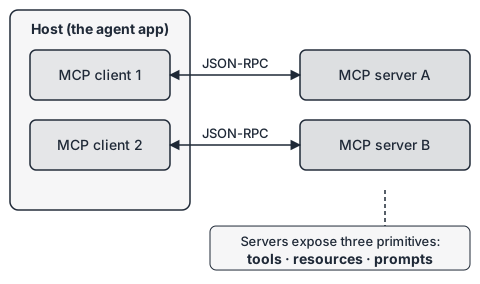
What is MCP? The Model Context Protocol is an open standard for how an AI application discovers and uses capabilities that live outside the model: tools it can call, data it can read and prompt templates it can offer. An application (the host) runs one client per server, and the two exchange JSON-RPC messages. MCP is a transport and a vocabulary. It is not a security boundary, and treating it as one is the most common misunderstanding.
The problem MCP solves
Before a shared protocol, every AI application wrote its own connector for every system: one integration for the issue tracker, another for the database, another for the file store, repeated for each application. Anthropic announced MCP in November 2024 with exactly this argument:
It provides a universal, open standard for connecting AI systems with data sources, replacing fragmented integrations with a single protocol.
— Anthropic, Introducing the Model Context Protocol
For a platform team the gain is the same as with any standard interface: a connector written once can serve several agent applications, and an agent application can use connectors it did not write. The cost is that a connector is now an attack surface shared by many.
Hosts, clients and servers
Three roles appear in the specification.
- Host. The application the user runs: a coding assistant, a chat application or an agent platform. It owns the model conversation, the user interface and the decisions about what is allowed.
- Client. A component inside the host that keeps one connection to one server. A host with three servers runs three clients.
- Server. A program that exposes capabilities. It can run locally as a child process or remotely over HTTP, and it can wrap anything: a database, a ticket system, a search index.
Messages are JSON-RPC. The client asks the server what it offers, the host presents that to the model, the model asks for a call, and the host (through the client) sends the request and returns the result.
The three primitives
Servers expose three kinds of things.
- Tools are functions the model can ask to run. They can have side effects.
- Resources are data the host can read and add to the context, such as files or records.
- Prompts are templates a user can pick, for example a standard review request.
Tools get most of the attention because they act. The sibling post Tool, skill or prompt? explains why tools carry the risk that the other two mostly do not.
What the specification says about consent
The specification does not stop at the wire format. It states principles about trust and safety, and the first is about people:
Users must explicitly consent to and understand all data access and operations
— Model Context Protocol, Specification, version 2025-06-18
On tools it is more pointed:
Tools represent arbitrary code execution and must be treated with appropriate caution.
— Model Context Protocol, Specification, version 2025-06-18
And in the tools section:
there SHOULD always be a human in the loop with the ability to deny tool invocations.
— Model Context Protocol, Tools (2025-06-18)
Note who these requirements address. The specification says hosts should obtain consent and clients should treat annotations with suspicion. The protocol carries the messages. It does not enforce the rules. Those are obligations on the implementer, and nothing in the wire format stops a host that ignores them.
Why MCP is a transport, not a security boundary
Three things follow from that.
-
Annotations are claims. A tool can describe itself as read-only. The specification says how to read that:
clients MUST consider tool annotations to be untrusted unless they come from trusted servers.
— Model Context Protocol, Tools (2025-06-18)
A server you did not write can claim anything, so its self-description cannot be the control.
-
Tool results are input. Text returned by a tool enters the model’s context. A hostile page, ticket or document can contain instructions. The protocol does not separate data from commands.
-
A user prompt is a weak gate. “Click allow” works for a few calls and fails at scale, because people stop reading. A decision that matters has to be made by something deterministic.
So the security work happens around MCP, in the host and the platform: which servers may be connected, which tools of which server an agent may see, what arguments are acceptable, and what gets recorded. That is the job of a policy gate in the harness; see What is an agent harness for where it sits, and Agent architecture is not application architecture for why it has to be designed in rather than bolted on.
A practical checklist for platform teams
- Inventory servers. Know every MCP server in use, who owns it and where it runs. Treat adding one like adding a dependency with network access.
- Pin and review. Pin the server version, read what its tools do and keep a copy of the review.
- Grant per agent. Do not expose all tools of a server to all agents. A tool that is not granted should not appear in the model’s tool list at all.
- Constrain arguments. A tool that accepts any string is harder to govern than one with a pattern and a length limit.
- Separate trust levels. Keep servers that read untrusted content apart from servers that can write or send.
- Authenticate remote servers. For remote servers use the authorization mechanisms in the specification rather than shared static keys, and keep credentials out of prompts.
- Log every call. Server, tool, arguments, decision, result size and who acted for whom.
What MCP does not give you
- No identity model for agents beyond what you add around it.
- No budget, rate or cost control.
- No guarantee that a server behaves as described.
- No answer to prompt injection. The protocol carries the text that injection lives in.
None of this is a flaw in the protocol. It is a statement of scope. A standard for connecting things is valuable because it is small, and the controls belong to the platform that uses it. An open platform such as open-agentix can use MCP servers as tool providers while keeping the decision about each call in its own gate.
Key takeaways
- MCP standardises how a host discovers and calls tools, resources and prompts exposed by servers.
- Roles: host (the application), client (one connection per server), server (the capability provider).
- The specification asks for consent and caution, but it places those obligations on implementers.
- MCP is a transport, not a security boundary: treat annotations and results as untrusted input.
- Put server inventory, per-agent grants, argument constraints and logging in the platform.
Sources
- Anthropic, Introducing the Model Context Protocol (2024-11-25)
- Model Context Protocol, Specification, version 2025-06-18
- Model Context Protocol, Tools (2025-06-18)