Agent evals 101: tasks, graders and transcripts
AI agent evaluation checks the outcome in the environment, not just the final message. Learn tasks, trials, graders, transcripts and pass@k vs pass^k.
This post is also available in Deutsch.
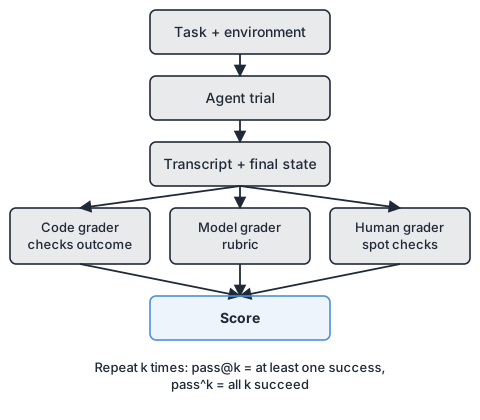
AI agent evaluation means running an agent on defined tasks, many times, and scoring what actually happened in the environment, not just what the agent said at the end. A chatbot eval compares an answer with a reference. An agent eval has to check side effects: was the file changed, does the row exist, was the right ticket created, and were forbidden actions avoided? This post defines the vocabulary and a minimal setup you can build in a day.
The vocabulary
A small set of terms covers most agent evals.
- Task: one test case with an input, an environment and a success condition.
- Trial: one attempt by the agent at a task. Agents are non-deterministic, so one task usually needs several trials.
- Transcript: the full record of a trial: messages, tool calls, tool results and final answer.
- Grader: the logic that scores a trial.
- Environment state: what is true in the world after the trial, such as database rows or files.
- Score: the aggregate over graders and trials.
Anthropic’s engineering team defines the grader in one sentence:
A grader is logic that scores some aspect of the agent’s performance.
Demystifying evals for AI agents (Anthropic, 2026)
Note “some aspect”. A single trial usually has several graders, each looking at a different property.
Grade the outcome, not the message
An agent that says “I have booked your flight” has not necessarily booked a flight. The reliable check looks at the world. The same article illustrates this with a booking scenario:
the outcome is whether a reservation exists in the environment’s SQL database.
Demystifying evals for AI agents (Anthropic, 2026)
Apply the idea to your own tasks. If the agent should open a pull request, query the repository. If it should file a ticket, read the tracker. If it should not touch a system, check that the system is unchanged. The transcript is still valuable, but as evidence for debugging and for grading how the agent worked, such as whether it called a forbidden tool, rather than as the main success signal.
Three kinds of graders
| Grader | Good for | Watch out for |
|---|---|---|
| Code | State checks, schema validation, tests passing, forbidden-call detection | Brittle if it checks wording instead of outcome |
| Model (LLM) | Rubric-based judgement of text quality, tone, completeness | Needs calibration against human labels; can be biased or inconsistent |
| Human | Calibrating the other graders, ambiguous or high-stakes cases | Slow and expensive; sample, do not grade everything |
Prefer code graders wherever the outcome can be checked deterministically. Use an LLM grader with an explicit rubric where judgement is unavoidable, and spot-check it with humans so you know whether its scores track yours. Never let a model grade its own work without a rubric and some independent check.
A minimal task definition
Keep tasks in version control, next to the agent definition they test:
id: refund-small-order
input: "Customer asks for a refund on order 1042 (EUR 19.90)."
environment: fixtures/shop-seed.sql
graders:
  - type: code
    check: "refunds table has one row for order 1042 with amount 19.90"
  - type: code
    check: "no call to tool payments.refund_large"
  - type: model
    rubric: "Reply is polite, states the refund amount, promises no timeline"
trials: 5
Start with 10 to 20 tasks drawn from real failures and real requests. Include negative tasks, where the right behaviour is to refuse or ask a question. An eval that only contains success cases rewards agents that never say no.
Reliability: pass@k versus pass^k
Because trials vary, one number is not enough. Two aggregates answer different questions:
- pass@k: the probability that at least one of k trials succeeds. It measures capability: can the agent do this at all, given a few tries?
- pass^k: the probability that all k trials succeed. It measures reliability: can you depend on it every time?
The pass^k metric comes from the τ-bench paper on tool-using agents:
We also propose a new metric (pass^k) to evaluate the reliability of agent behavior over multiple trials.
τ-bench: A Benchmark for Tool-Agent-User Interaction in Real-World Domains (arXiv, 2024)
If a task succeeds 80 % of the time per trial, and the trials are independent, pass@3 is high but pass^3 is about 51 %, and pass^8 is about 17 %. For a customer-facing process that runs thousands of times, pass^k is the number that matches how users experience the agent. Use pass@k for exploration and pass^k for release gates.
Public benchmarks and your own evals
Public benchmarks are useful for comparing models, and their authors state why a realistic task source matters. The SWE-bench paper puts it this way:
We find real-world software engineering to be a rich, sustainable, and challenging testbed for evaluating the next generation of language models.
SWE-bench: Can Language Models Resolve Real-World GitHub Issues? (arXiv, 2023)
The lesson for your own evals is the data source: real issues, not invented puzzles. A public score does not tell you whether your agent, with your tools and your policies, handles your tickets. Build a private suite from your own history and keep it fresh as the process changes.
Running evals as part of the harness
Evals belong in the agent harness, not in a notebook: the harness resets the environment, runs the trials, stores transcripts and gates releases on the scores. See what is an agent harness for the surrounding pieces. When a prompt or skill changes, the eval suite should run before the change ships; this is also the cure for the habit described in prompt sprawl and AI slop, where prompts grow with nothing checking that they help. A sound structure, as argued in architecture before prompts, also makes evals easier because each component has a testable contract.
Common mistakes
- Grading the final message only, so side effects go unchecked.
- Running one trial per task and reporting a single pass rate.
- Fixtures that leak the answer into the environment.
- Model graders without a rubric or human calibration.
- Never retiring tasks that every version passes; they no longer tell you anything.
Key takeaways
- Score the state of the environment after the run; the transcript is evidence, not proof.
- Use code graders first, model graders with a rubric second, humans to calibrate.
- Run several trials; report pass@k for capability and pass^k for reliability.
- Build tasks from real requests and real failures, including cases where the agent should refuse.
- Run the suite in the harness before every prompt, skill or policy change ships.
Sources
- Demystifying evals for AI agents, Anthropic, 2026-01-09.
- τ-bench: A Benchmark for Tool-Agent-User Interaction in Real-World Domains, arXiv, 2024.
- SWE-bench: Can Language Models Resolve Real-World GitHub Issues?, arXiv, 2023.