An architecture review for agent systems in one page
An AI architecture review template for agents on one page: purpose, boundaries, data flow, contracts, autonomy and failure paths, with questions for each.
This post is also available in Deutsch.
A one-page AI architecture review catches most design errors before an agent goes live, because most of those errors are not about the model. They are about unclear boundaries, undefined hand-offs, data that flows where nobody drew it and failure paths nobody walked through. This post gives a template with seven sections, the questions to ask in each, and a way to record the outcome so the review becomes an artefact the team keeps, not a meeting that is forgotten.
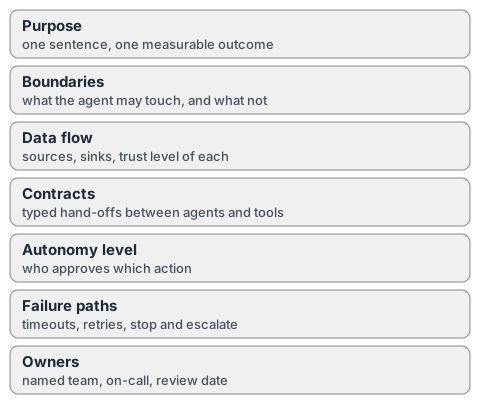
Use it as a conversation guide of 45 to 60 minutes with the people who built the system and someone who did not. One page forces choices; if a section needs three pages, that is the finding.
Start from the simplest thing that works
Anthropic’s guidance on building agents makes the case for restraint:
Consistently, the most successful implementations use simple, composable patterns rather than complex frameworks.
Source: Building Effective AI Agents, Anthropic, 2024-12-19 (the page has been updated since; the sentence is from the core text).
The same article separates two kinds of system:
Workflows are systems where LLMs and tools are orchestrated through predefined code paths.
The rest, where the model directs its own steps, are agents. A review should start by asking which one you are building and why; see workflows vs agents. If a fixed workflow does the job, the review gets shorter, because the control flow is code you can read.
Multi-agent designs deserve extra scepticism. A study of failures in such systems opens with a sober observation:
Despite enthusiasm for Multi-Agent LLM Systems (MAS), their performance gains on popular benchmarks are often minimal.
Source: Why Do Multi-Agent LLM Systems Fail?, arXiv (first posted 2025-03-17; the quote is from the latest version’s abstract).
That is not an argument against decomposition for safety, as in least privilege for agents. It is a reason to ask what each extra agent buys you.
The one-page template
1. Purpose
One sentence on what the system does, and one measurable outcome. If you cannot write the outcome, you cannot tell later whether the system works. The background is in architecture before prompts.
Questions: Who is the user? What happens if the system does nothing? What is explicitly out of scope?
2. Boundaries
What the system may touch and what it may not: tools, systems, data classes, networks, tenants. Draw a box and list what crosses it.
Questions: Which credentials does each component hold? What is the blast radius of the worst single component? Which parts are third-party?
3. Data flow
Sources, sinks and the trust level of each. Mark where untrusted text enters the model’s context and where output leaves the system. The method is described in data flow first.
Questions: Where does personal or confidential data go? Can any path combine private data, untrusted input and an outbound channel? Where is data stored, and for how long?
4. Contracts
Typed interfaces between agents and tools: inputs, outputs, errors, limits. A hand-off in free text is a contract nobody can test; see interface contracts for agents.
Questions: Is every hand-off a schema? Who validates it, and what happens on a violation? Are tool arguments constrained?
5. Autonomy level
Who decides what. Mark each action as automatic, approved by a person or forbidden. Irreversible and externally visible actions should not be automatic by default.
Questions: Which actions need approval, from whom, within what time? What does the system do while waiting? Can a person take over?
6. Failure paths
For each external dependency and each step: timeout, retry limit, fallback, and what the user sees. Include the model: provider outage, rate limits, a refusal, a malformed answer.
Questions: What stops a loop? What is the maximum cost of one run? How do you stop the system, and how do you know it stopped?
7. Owners
A named team for the system, for each tool and for each skill, plus on-call, a review date and the place where decisions are recorded.
Questions: Who is paged? Who may change prompts, skills and models, and through which review?
Record decisions, not just opinions
The review’s output is a short list of decisions with reasons. Keep them as architecture decision records in the repository: title, context, decision, consequences, date. When the agent changes, the ADR shows what was decided and why, which is more useful than a diagram that has drifted.
Fit with secure development guidance
If you already follow secure-development guidance, map the review onto it. The UK NCSC guidelines are organised around four areas:
four key areas within the AI system development life cycle: secure design, secure development, secure deployment, and secure operation and maintenance
Source: Guidelines for secure AI system development, UK National Cyber Security Centre, 2023-11-27.
Sections 1 to 5 of the template are mostly secure design; section 6 straddles deployment and operation; section 7 is operation and maintenance. Re-run the review when you change a tool, a model or an autonomy level, not only at launch.
An example artefact
A handover graph is a good companion to the page: agents as nodes, handovers as edges labelled with contract names. In the current demo such a graph is generated for an example process, and the review asks of it the same question as of any diagram: does it match what actually runs?
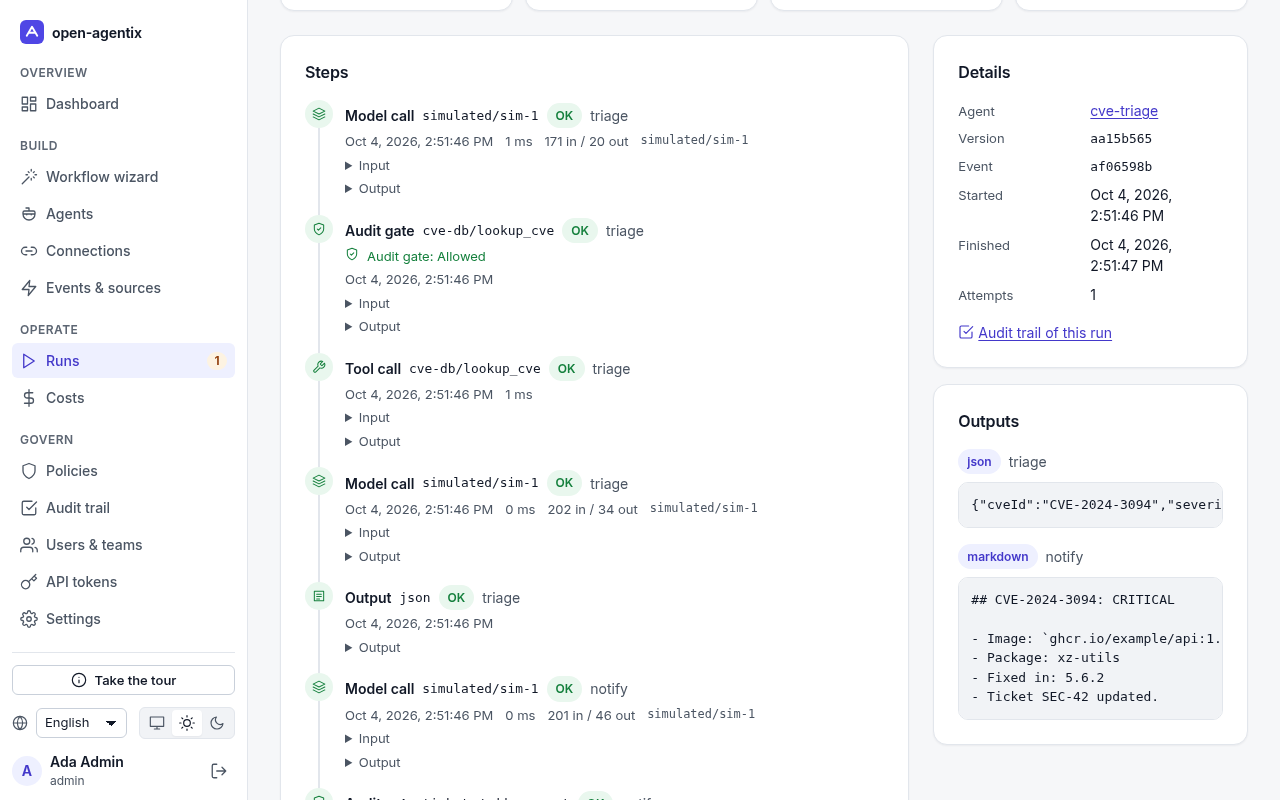
Screenshot of the current demo (fake data).
Key takeaways
- A one-page review of purpose, boundaries, data flow, contracts, autonomy, failure paths and owners catches most design errors.
- Start with the question whether a fixed workflow is enough; add agents only where they earn their place.
- Free-text hand-offs are untestable contracts; use schemas.
- Write down decisions as short ADRs and re-run the review when tools, models or autonomy change.
Sources
- Anthropic, Building Effective AI Agents, 2024-12-19.
- arXiv, Why Do Multi-Agent LLM Systems Fail?, 2025.
- UK National Cyber Security Centre, Guidelines for secure AI system development, 2023-11-27.