Ops series recap: agent platforms are not that different from classic operations
AI platform operations recap: a table of twelve disciplines showing what carries over from DevOps and SRE and what is genuinely new for agents.
This post is also available in Deutsch.
AI platform operations looks new from the outside and familiar from the inside. Most of what keeps an agent platform healthy is what keeps any production service healthy: identity, least privilege, controlled change, observability, incident response, objectives, cost control, audit, runbooks, patching and secrets. Some things are genuinely different, mainly because the system’s behaviour depends on text and on a model you do not control. This recap closes the ops series with a side-by-side table, and for each row says what carries over and what is new.
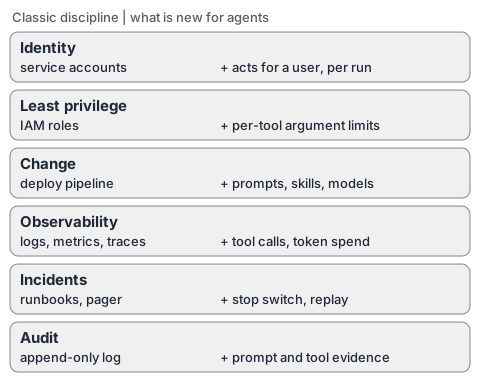
The short version: if your organisation operates services well, you are most of the way there; if it does not, agents will expose that faster. The series opened with the argument in agent ops is just ops; this is the check against what followed.
Side by side
| Discipline | Classic operations | What is new for agents |
|---|---|---|
| Identity | Service accounts, workload identity | An agent acts for a user and on its own; both must be recorded per call |
| Least privilege | Roles and scopes per service | Limits on tool arguments, not just on which tool, and per-step decomposition |
| Change management | Code review, CI, staged rollout | Prompts, skills, tool descriptions and model versions are changes too |
| Deployment | Immutable artefacts, canaries | Behaviour can change without a deploy when a provider updates a model |
| Observability | Logs, metrics, traces | Traces of model calls and tool calls, token and cost metrics, content-aware review |
| Incidents | Pager, runbook, postmortem | Stop switch, credential revocation, replay of what the agent did |
| SLOs | Availability, latency, error rate | Task success and quality objectives alongside latency |
| Cost | Capacity planning, budgets | Variable, usage-driven spend; budgets per run, agent and tenant |
| Audit | Append-only logs, access records | Evidence of what the model was asked, what it proposed and what policy decided |
| Runbooks | Documented procedures | Procedures an agent may follow, written as skills with approvals |
| Patching | OS and dependency updates | Also skills, MCP servers, model versions and prompt libraries |
| Secrets | Vault, rotation | Keep secrets out of model context; credentials live in the tool layer |
Several rows have a dedicated post: deploying agent changes safely, audit trails vs logs, and capacity and rate limits.
What carries over unchanged
Toil still hurts. The SRE book defines it precisely:
Toil is the kind of work tied to running a production service that tends to be manual, repetitive, automatable, tactical, devoid of enduring value
Source: Site Reliability Engineering, Chapter 5: Eliminating Toil (the book appeared in 2016; the web page is undated).
Agent platforms create new toil unless you prevent it: approving the same safe action by hand every day, re-running evals manually, rotating tokens on a calendar reminder. The cure is the usual one: automate it or remove the need. Agents can also help remove toil, but an agent that automates toil without limits is a new risk to operate.
Incident response is a discipline, not a tool. NIST’s incident response recommendations make the point that preparation pays off:
Doing so can help organizations prepare for incident responses, reduce the number and impact of incidents that occur
Source: SP 800-61 Rev. 3, Incident Response Recommendations and Considerations for Cybersecurity Risk Management, NIST, 2025-04-03.
The agent-specific preparation is small and concrete: who can stop a run, how credentials are revoked in minutes, how the record of a run is preserved, and which actions an agent could have taken that need to be undone.
What is genuinely new
- Behaviour comes from text. Prompts, skill instructions and tool descriptions steer actions, so a wording change can alter what the system does. Version and review them like code.
- The input can attack the system. Untrusted content processed by the model can contain instructions. Normal input validation does not remove this; you need structural controls such as gates between model output and side effects.
- Outputs are probabilistic. The same input may produce different results, so an objective such as “success rate on this task set” replaces “the function returns the right value”.
- A vendor can change the component. A hosted model may be updated or retired on the provider’s schedule. Pin versions where possible and keep an eval set to detect drift.
- Cost scales with behaviour. A loop or a verbose prompt shows up directly on the bill.
Telemetry standards are catching up
You need not invent your own telemetry shape. The OpenTelemetry project describes the direction:
establish standards around the shape of the telemetry generated by agent apps to avoid lock-in
Source: AI Agent Observability - Evolving Standards and Best Practices, OpenTelemetry, 2025-03-06.
Emit traces with spans for model calls and tool calls in a vendor-neutral format, so you can change backends later. Standards are still evolving, so isolate the mapping in one place.
An illustration for one row
For the audit row, the current demo shows an audit chain: hash-linked entries for an example run with a verification badge. The idea carries to any stack: records that cannot be silently edited, so that “what happened” has an answer you can verify.
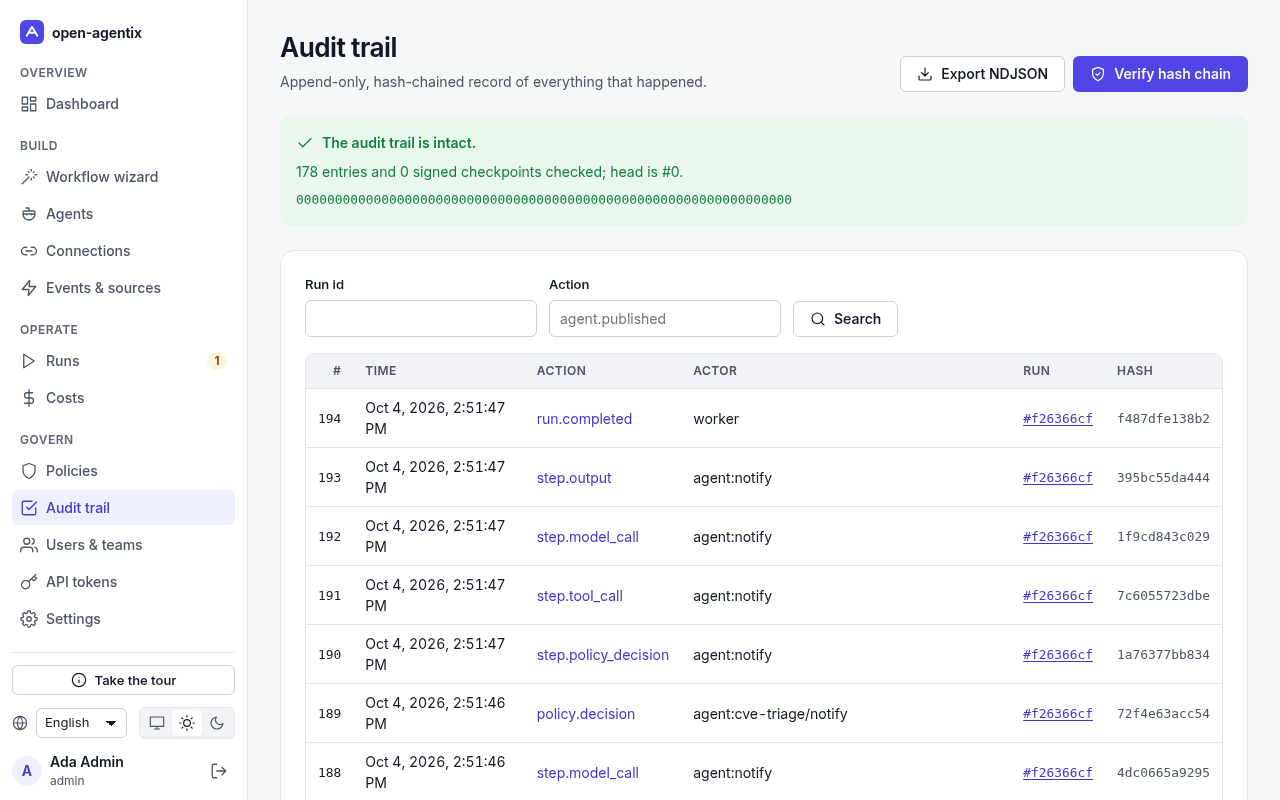
Screenshot of the current demo (fake data).
A self-test
Pick any row of the table and ask three questions. Do we do the classic version well? Have we added the agent-specific part? Who owns it? Rows where the answer to the first question is “no” are the cheapest improvements, because the agent part builds on them.
Key takeaways
- Agent platforms are operated with the same disciplines as other services; the foundations carry over.
- New parts: behaviour from text, hostile input, probabilistic output, vendor-changed components and usage-driven cost.
- Treat prompts, skills, tool descriptions and models as changes with review and rollout.
- Prepare incident response before the first incident: stop, revoke, replay.
- Use vendor-neutral telemetry and keep toil under control.
Sources
- Google, Site Reliability Engineering, Chapter 5: Eliminating Toil.
- NIST, SP 800-61 Rev. 3, 2025-04-03.
- OpenTelemetry, AI Agent Observability - Evolving Standards and Best Practices, 2025-03-06.