Ops series: capacity, rate limits and runaway agents
LLM rate limiting for agents: nested run, agent, tenant and provider limits stop one looping agent from starving the rest. With a config sketch and alerts.
This post is also available in Deutsch.
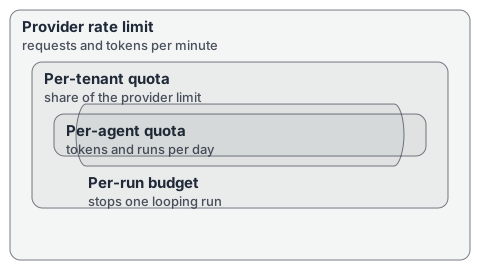
One agent stuck in a retry loop can use a whole day’s tokens in an hour, and take every other agent’s rate limit with it. LLM rate limiting for agents therefore needs layers: a budget per run, a quota per agent, a quota per tenant and, outside your control, the provider’s own limit. Each layer stops a different failure, and together they make saturation visible before it becomes an outage. This post is part of the ops series; it assumes you already track spend as described in FinOps for agents.
Saturation is a golden signal for agents, too
Google’s SRE book lists what to watch on any service:
The four golden signals of monitoring are latency, traffic, errors, and saturation.
Source: Site Reliability Engineering, Chapter 6: Monitoring Distributed Systems (the book appeared in 2016; the web page is undated).
For an agent platform, map them like this:
| Signal | Agent platform meaning |
|---|---|
| Latency | Time per model call and per run, split into queueing and generation |
| Traffic | Runs, model calls and tokens per minute |
| Errors | Provider 429 and 5xx responses, tool failures, policy denials |
| Saturation | How close you are to the provider limit, the GPU’s capacity or a quota |
Saturation is the signal people forget, because with a hosted model it looks like someone else’s problem. It is not: a 429 from the provider is your agents failing.
The failure the layers prevent
OWASP lists this class of problem as LLM10:
Unbounded Consumption occurs when a Large Language Model (LLM) application allows users to conduct excessive and uncontrolled inferences
Source: LLM10:2025 Unbounded Consumption, OWASP Gen AI Security Project.
With agents the “user” is often another piece of software, and a loop needs no attacker: a tool that returns an error the model keeps retrying is enough. The result is the same: excessive, uncontrolled inference, a bill nobody planned, and neighbours starved of capacity.
Four layers of limits
1. Per-run budget. Cap tokens, model calls, tool calls and wall-clock time for one run. When a run hits the cap, stop it with a clear status and keep the partial record. This is the cheapest control and catches most loops.
2. Per-agent quota. A daily or hourly ceiling for one agent, across all its runs. A new agent version that loops will hit this before it harms anyone else.
3. Per-tenant quota. A ceiling per team, product or customer, usually a share of what you hold at the provider. This is the layer that keeps one team from starving another.
4. Provider rate limit. Requests and tokens per minute, set by the provider and plan. Treat it as a shared pool and allocate it down through layers 3 to 1. The sum of tenant quotas should be at or below the pool, or you must queue and prioritise.
A sketch of how this could look in configuration. The keys are illustrative, not a specific product’s schema:
provider:
  anthropic:
    tokens_per_minute: 400000
    requests_per_minute: 1000
tenants:
  support:
    share: 0.5            # of the provider pool
    daily_budget_usd: 120
agents:
  triage:
    tenant: support
    daily_tokens: 8000000
    run:
      max_tokens: 200000
      max_model_calls: 40
      max_tool_calls: 25
      max_seconds: 300
Local GPU capacity is a limit, too
If you run models yourself, the limit is memory and throughput rather than a quota. The vLLM paper starts from this point:
High throughput serving of large language models (LLMs) requires batching sufficiently many requests at a time.
Source: Kwon et al., Efficient Memory Management for Large Language Model Serving with PagedAttention, arXiv, 2023-09-12.
The operational reading: a serving stack gets more efficient with enough concurrent requests, but each request holds memory, so there is a ceiling where latency climbs sharply. Measure it with your own prompts, set the concurrency limit below that point and put a queue in front. Rate limits then protect your own hardware instead of a provider’s.
Behaviour under pressure
Limits need defined behaviour, otherwise they only move the failure:
- Retry with backoff and jitter on 429, honouring the provider’s retry hint. Cap the number of retries; unlimited retries are the loop again.
- Queue by priority. Interactive runs ahead of batch work, and a tenant over quota waits instead of failing others.
- Degrade deliberately. Name a fallback model for non-critical work, and decide in advance which agents must not fall back.
- Fail fast and visibly. A run stopped by a budget should say so in its status, and the owner should be told.
- Stop, do not throttle forever. A run that has used 80 percent of its budget without progress is a candidate for early stop.
What to alert on
- Provider 429 rate above a small threshold for five minutes.
- Any tenant above 80 percent of its quota before the period ends.
- A run that hit its budget cap, grouped by agent version, so a bad release is obvious.
- Queue wait time above your latency objective; see SLOs for agents.
- Spend per hour compared with the same hour last week.
Caching and prompt design reduce the load before limits apply; see prompt caching and token budgets.
An example view
In the current demo, a budgets view shows spend against budget per agent for invented example tenants, including a run that was stopped by its limit. The point of such a view is that a stop is an expected, recorded outcome, not a mystery.
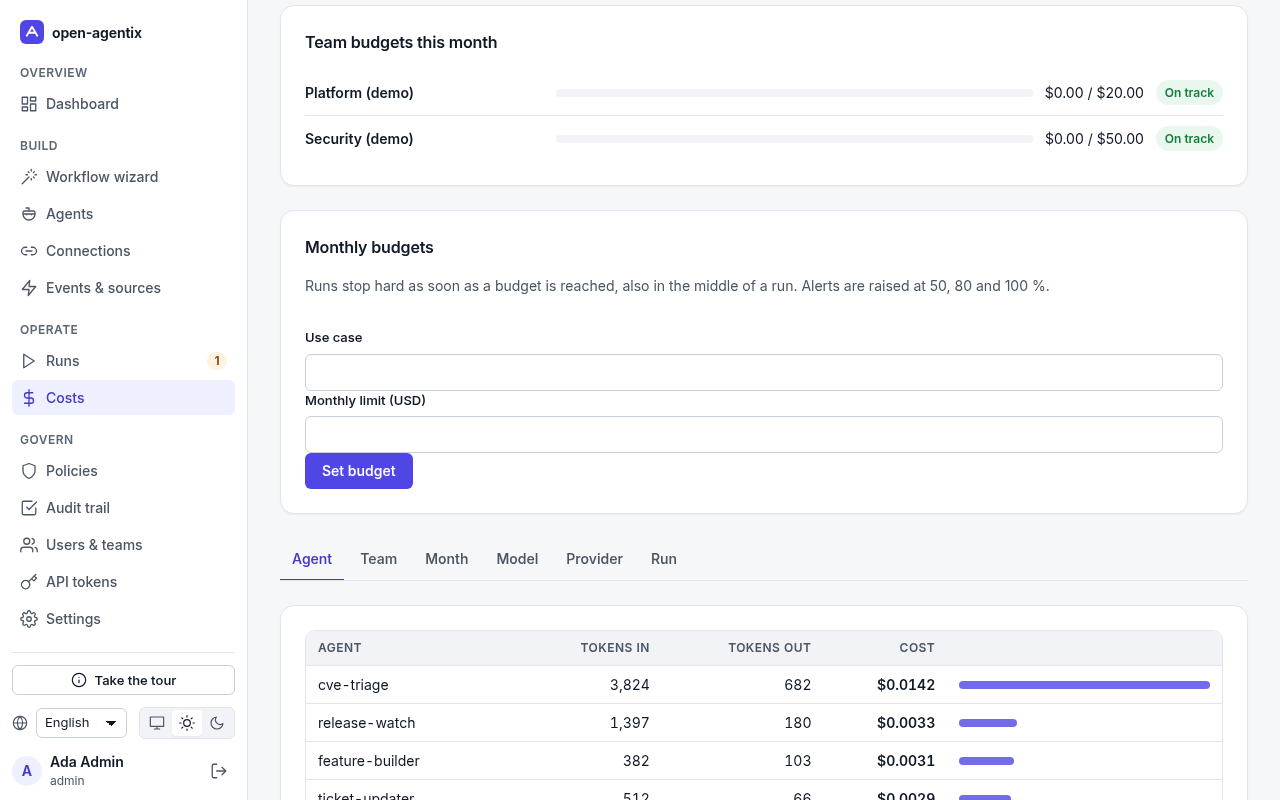
Screenshot of the current demo (fake data).
Key takeaways
- Use four nested limits: run, agent, tenant and provider.
- Saturation is a golden signal; a provider 429 means your agents are failing.
- Loops need no attacker, only a retryable error: cap retries and run length.
- Define behaviour under pressure: backoff, priority queues, deliberate fallback, visible stops.
- Local GPU serving has a concurrency ceiling; measure it and queue in front.
Sources
- OWASP Gen AI Security Project, LLM10:2025 Unbounded Consumption.
- Google, Site Reliability Engineering, Chapter 6: Monitoring Distributed Systems.
- Kwon et al., Efficient Memory Management for Large Language Model Serving with PagedAttention, arXiv.