Third-party skills are supply chain: an agent skill security checklist
Agent skill security starts with treating third-party skills as dependencies. A checklist for provenance, pinning, full review and least privilege.
This post is also available in Deutsch.
Agent skill security begins with one reframing: installing a third-party skill is adding a dependency. A skill is a folder of instructions and often scripts that run with the agent’s permissions, so a malicious or careless one can read data, call tools and execute code on your behalf. Review it as you would review a library that gets run on your build server, and then some, because part of it is written in natural language aimed at your agent.
Why skills are different from documents
A skill looks like documentation: a Markdown file with a name and a description, perhaps some reference files and scripts. Its design is what makes it powerful. Anthropic’s engineering team describes the mechanism:
Progressive disclosure is the core design principle that makes Agent Skills flexible and scalable.
Equipping agents for the real world with Agent Skills (Anthropic, 2025)
Only a short description sits in the context all the time; the full instructions and files load when the agent decides the skill is relevant. For security, that has two consequences. First, a reviewer who reads only the description sees a fraction of what the agent will later read. Second, the content that loads on demand arrives as trusted-looking instructions, which is the opening for the attacks described in indirect prompt injection. For the structure of a well-formed skill, see anatomy of an agent skill.
The same article is direct about what to do with skills from less-trusted sources:
When installing a skill from a less-trusted source, thoroughly audit it before use.
Equipping agents for the real world with Agent Skills (Anthropic, 2025)
The rest of this post turns “thoroughly audit” into a concrete checklist.
What can go wrong
- Hidden instructions. Text in the skill, in a referenced file or in an HTML comment tells the agent to ignore rules, send data elsewhere or hide its actions.
- Malicious scripts. A bundled script downloads and runs code, reads environment variables or writes to credential files.
- Runtime fetches. The skill tells the agent to read instructions from a URL at run time. The URL’s owner can change the content after you reviewed it.
- Tool poisoning. Descriptions of tools that a skill relies on carry hidden directions. Invariant Labs described this for MCP tools as
a specialized form of indirect prompt injections
MCP Security Notification: Tool Poisoning Attacks (Invariant Labs, 2025)
- Silent updates. The upstream repository changes after install and your agent follows the new text.
- Over-broad permissions. The skill asks for, or assumes, tools it does not need.
The review checklist
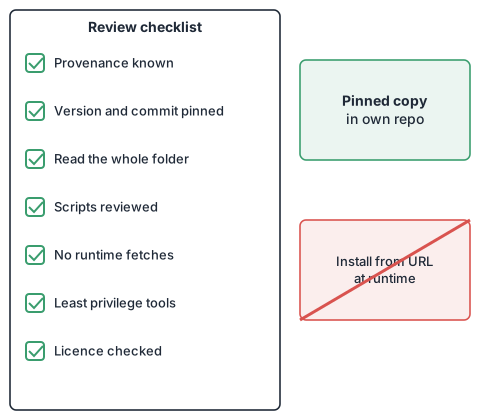
1. Provenance
Who wrote it, where does it live, and can you verify that? Prefer authors and repositories with a visible history, signed tags or releases, and a licence. An anonymous snippet from a forum is not a source. Record the origin (URL, commit, date) in a file next to the copy.
2. Pin the version
Never track “latest”. Pick an exact commit or release and keep a copy of that version. A skill that changes upstream should require a new review, in the same way a dependency bump does. This is the discipline of change management for agents applied to inbound artefacts.
3. Read the whole folder
Read every file, not just the main instruction file: references, templates, scripts, hidden files, binary blobs. Search for the usual suspects:
grep -rniE "curl|wget|http[s]?://|eval|base64|exec|subprocess|\.env|ssh|token|password" skill-folder/
grep -rniE "ignore (all|previous)|do not tell|secretly|without asking" skill-folder/
A search is a helper, not a verdict. Read the hits, and read what the search cannot find, such as text encoded in unusual ways. If a file is a binary or minified blob you cannot read, do not install.
4. No runtime fetches
The skill must not instruct the agent to download instructions, scripts or packages when it runs. If it needs a dependency, vendor it into the pinned copy or install it from a reviewed lockfile. A rule such as “never load instructions from the internet at runtime” is simple to state and simple to check by the grep above.
5. Review the scripts like code
For each script: what does it read, write, execute and send over the network? Run it in a sandbox without credentials first. Check that it does not reach outside the skill’s own working directory.
6. Least privilege
Grant the agent that uses the skill only the tools the skill needs, and restrict their arguments. A formatting skill needs no network and no write access outside the project. See least privilege for agents for how to scope tools per agent.
7. Keep a pinned copy in your own repository
Install from your own reviewed copy, not from a URL. That gives you a diff for every update, a place to record the review, and independence from upstream changes or takedowns.
Verify integrity where you can
OWASP’s guidance on LLM supply chain risks is written about models, but the principle transfers to any artefact you pull in:
Only use models from verifiable sources and use third-party model integrity checks with signing and file hashes
LLM03:2025 Supply Chain (OWASP Gen AI Security Project)
For skills, the equivalents are signed tags or releases where the author provides them, and a hash of your reviewed copy recorded in your repository, so a changed file is detected.
After installation
Review does not end at install. Log which skills were loaded in each run, so an incident can be traced to a skill version. Watch for behaviour changes after an update. Keep an inventory of installed skills with owner, version, source and review date, and remove what nobody uses. Limit what a compromised skill could do by default, using policy gates that do not depend on the model’s cooperation.
Limits
No checklist makes an unknown skill safe, because natural-language instructions can be disguised in ways no scanner reliably catches. The honest position is: review reduces risk, least privilege limits the damage, and anything that cannot be reviewed is not installed.
Key takeaways
- A third-party skill is a dependency that can carry instructions and executable code.
- Establish provenance, pin an exact version and read the entire folder, not just the main file.
- Forbid runtime fetches; vendor or lock what the skill needs.
- Review scripts like code and run them in a sandbox without credentials first.
- Install from a pinned copy in your own repository and give the agent only the tools the skill needs.
Sources
- Equipping agents for the real world with Agent Skills, Anthropic, 2025-10-16.
- LLM03:2025 Supply Chain, OWASP Gen AI Security Project.
- MCP Security Notification: Tool Poisoning Attacks, Invariant Labs, 2025-04-01.