Agent platform readiness: the checklist that ties the series together
AI agent production readiness checklist across architecture, skills, security, operations, cost and evaluation, each item linked to the post behind it.
This post is also available in Deutsch.
Readiness for production is not one question; it is six. Is the architecture reviewed, are skills governed, is security checked, can you operate it, do you control cost and can you tell whether it works? This AI agent production readiness checklist puts one set of items across all six areas, each linked to the post in this series that explains it. Use it as the final gate before a first run in production, and as a periodic review afterwards. It does not replace a formal risk process; it makes sure the basic questions were asked.
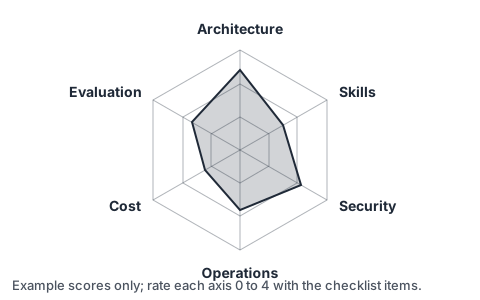
Score each area from 0 (nothing in place) to 4 (in place, tested and owned), plot the six values on the radar, and look at the weakest axis, not the average. A platform that is excellent at evaluation and has no incident response is not ready.
How this fits larger frameworks
Frameworks exist for organisations that need one. The NIST AI Risk Management Framework describes itself as voluntary:
The NIST AI Risk Management Framework (AI RMF) is intended for voluntary use and to improve the ability to incorporate trustworthiness considerations
Source: AI Risk Management Framework, NIST (AI RMF 1.0 released 2023-01-26).
And for the security side, the OWASP agentic list is the natural companion:
identifies the most critical security risks facing autonomous and agentic AI systems.
Source: OWASP Top 10 for Agentic Applications for 2026, OWASP Gen AI Security Project, 2025-12-09.
The checklist below is practical and narrower: it is about whether a platform team can run agents safely day to day.
1. Architecture
- The system has a one-page review covering purpose, boundaries, data flow, contracts, autonomy and failure paths. See an architecture review for agent systems in one page.
- A fixed workflow was considered before choosing an agent.
- Hand-offs between agents and tools are schemas, not prose.
- Decisions are recorded with reasons, and the review has a date for repetition.
2. Skills
- Skills come from a catalog with owners, versions and review dates. See building an internal skills catalog.
- Every skill was reviewed for security and has at least one eval.
- Consumers pin versions; upgrades are reviewed like dependencies.
- Unowned or outdated skills are deprecated on a schedule.
3. Security
- The twenty questions of the agent security checklist are answered per agent, with evidence.
- No single agent combines private data, untrusted input and an outbound channel.
- A deterministic gate stands between model output and side effects; see policy decides, audit proves.
- Each agent holds only the tools its step needs; see least privilege for agents.
4. Operations
- The row-by-row comparison in agent platforms are not that different from classic operations was walked through and gaps have owners.
- A stop switch, credential revocation and run replay were tested, not just documented.
- Observability covers model calls, tool calls, errors and saturation.
- Changes to prompts, skills and models go through review and staged rollout.
5. Cost
- Budgets exist per run, per agent and per tenant, and a run that hits a budget stops with a visible status.
- Spend is attributed per use case, and someone reviews it regularly.
- Provider rate limits and local capacity are known and monitored.
- A cost per accepted change can be computed.
6. Evaluation
- There is an eval set for the agent’s main tasks, run on every change to prompts, skills or model. A grader is defined in plain terms:
A grader is logic that scores some aspect of the agent’s performance.
Source: Demystifying evals for AI agents, Anthropic, 2026-01-09.
- Outcomes are checked in the environment, not only in the transcript. The same article gives an example of what that means:
the outcome is whether a reservation exists in the environment’s SQL database.
- Objectives are written as SLOs with a measured indicator. The SRE book gives the definition:
An SLO is a service level objective: a target value or range of values for a service level that is measured by an SLI.
Source: Site Reliability Engineering, Chapter 4: Service Level Objectives (the book appeared in 2016; the web page is undated).
- A baseline exists to compare against, so improvement can be shown.
Worked example: the check before the first run
The current demo has an agent check or plan view: for an example process it lists the tools, policies and budget the agent would use before its first run. That is the readiness idea in miniature: before anything runs, a reader can see what the agent may touch and what limits apply, and then decide.
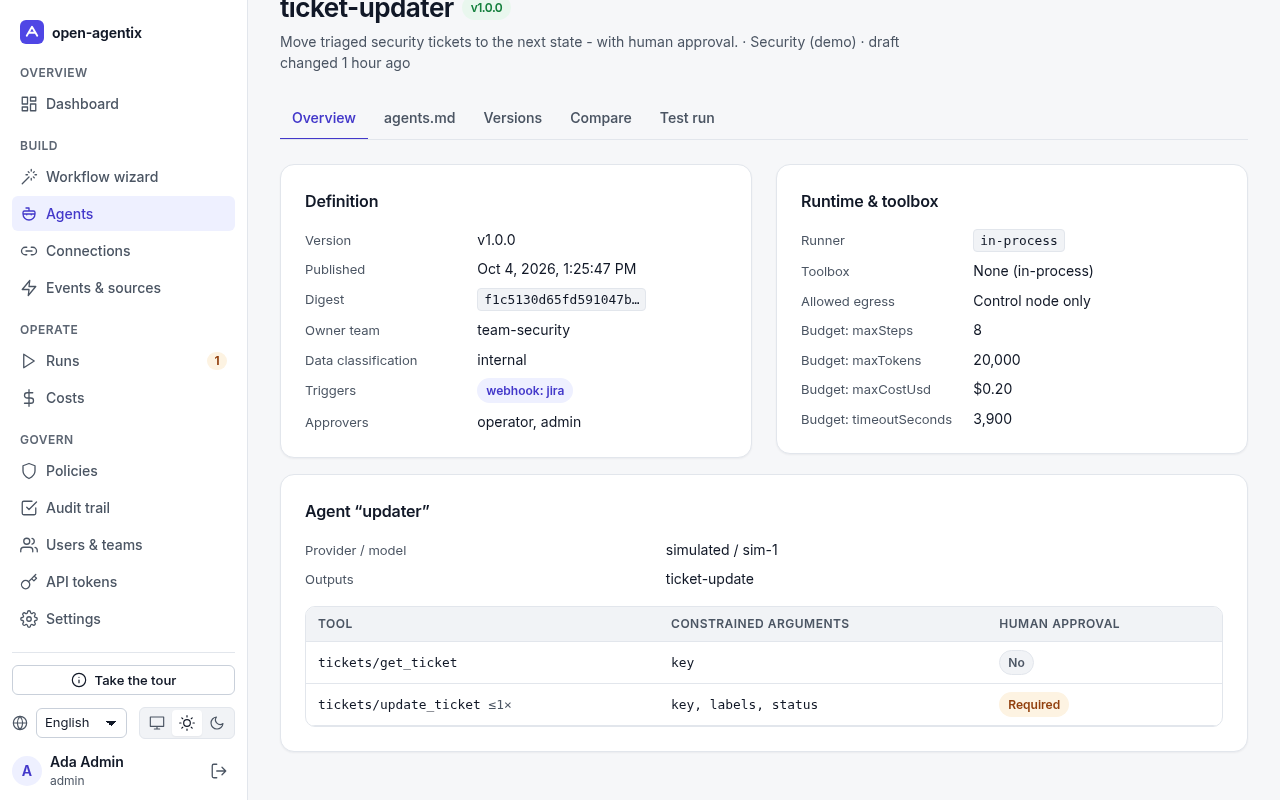
Screenshot of the current demo (fake data).
Using the checklist
- Score honestly. If you cannot show evidence for an item, it is a 0.
- Set a threshold. For a production launch, require at least 3 of 4 on security, operations and evaluation, and a plan for the rest.
- Assign owners and dates to every unchecked box.
- Repeat after any change of model, tool set or autonomy level, and at least quarterly.
- Keep the record with the architecture decision records, so the next reviewer sees what was accepted and why.
Key takeaways
- Readiness spans six areas: architecture, skills, security, operations, cost and evaluation.
- Judge by the weakest axis, not the average.
- Every item needs evidence; “probably” is a zero.
- Test the stop switch, revocation and replay; documentation alone is not readiness.
- Re-run the checklist when the model, tools or autonomy change.
Sources
- OWASP Gen AI Security Project, OWASP Top 10 for Agentic Applications for 2026, 2025-12-09.
- NIST, AI Risk Management Framework.
- Anthropic, Demystifying evals for AI agents, 2026-01-09.
- Google, Site Reliability Engineering, Chapter 4: Service Level Objectives.